5 Surprising Truths About GEO & AI’s Real Impact on Search in India
Table of Contents
ToggleThe Search Revolution Nobody Saw Coming
For more than two decades, Search Engine Optimization (SEO) has been the foundation of digital visibility. Businesses invested heavily in rankings, backlinks, keywords, and content strategies to secure top positions on search engines.
But in 2026 and beyond, a new force is reshaping how people discover information online: Artificial Intelligence.
This shift has given rise to a new discipline called GEO (Generative Engine Optimization).
GEO focuses on helping brands, websites, and content creators become visible within AI-generated answers rather than only ranking on traditional search engine result pages.
In India—one of the world’s fastest-growing digital economies—the impact of AI on search is particularly significant. With over 900 million internet users and a rapidly expanding AI adoption rate, businesses can no longer afford to view search solely through the lens of traditional SEO.
owever, many marketers still misunderstand what GEO means and how AI is influencing online visibility.
Let’s explore five surprising truths about GEO and AI’s real impact on search in India.
Table of Contents
Truth #1: AI Is Not Replacing Search—It's Replacing Parts of the Search Journey
One of the biggest misconceptions is that AI will completely replace search engines.
The reality is much more nuanced.
Search isn’t disappearing. Instead, AI is changing how users move through the search process.
Traditionally, a user searching for “best CRM software for small businesses” would:
- Enter a query into Google.
- Browse multiple websites.
- Compare features.
- Read reviews.
- Make a decision.
Today, AI tools can summarize much of this information instantly.
Users often receive:
- Product comparisons
- Pros and cons
- Pros and cons
- Buying guidance
- Frequently asked questions
all within a single AI-generated response.
This means fewer clicks for informational searches but not necessarily fewer opportunities for businesses.
What changes is where visibility happens.
Instead of competing solely for a top Google ranking, brands now compete to become trusted sources cited by AI systems.
For Indian businesses, this means the goal is no longer just ranking #1.
The goal is becoming the source that AI trusts enough to reference.
Truth #2: GEO Rewards Authority More Than Traditional SEO Ever Did
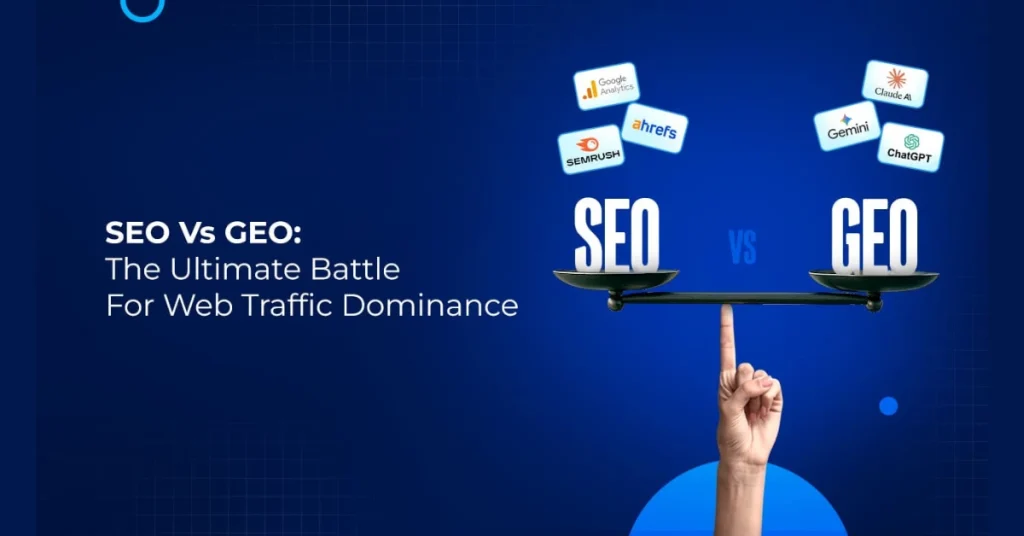
Traditional SEO often allowed websites to rank through technical optimization, aggressive backlink strategies, and keyword targeting.
AI systems evaluate content differently.
Generative AI models are designed to synthesize information from sources they perceive as trustworthy, authoritative, and relevant.
This creates a major shift.
A website that ranks highly because of strong SEO tactics may not necessarily be referenced by AI-generated answers.
Meanwhile, a highly credible source with expert insights may appear frequently in AI responses despite not dominating search rankings.
For Indian businesses, this presents a powerful opportunity.
Companies that demonstrate:
- Industry expertise
- Original research
- Case studies
- Data-driven insights
- Expert commentary
are more likely to become trusted references.
Consider two marketing agencies:
Agency A publishes 100 keyword-focused articles
Agency B publishes 20 high-quality reports with proprietary data on consumer behavior in India.
In an AI-driven ecosystem, Agency B may become more visible because its content offers unique information that AI systems can cite and summarize.
GEO rewards substance over volume.
The emphasis is shifting from “How much content do you publish?” to “How valuable and trustworthy is your content?”
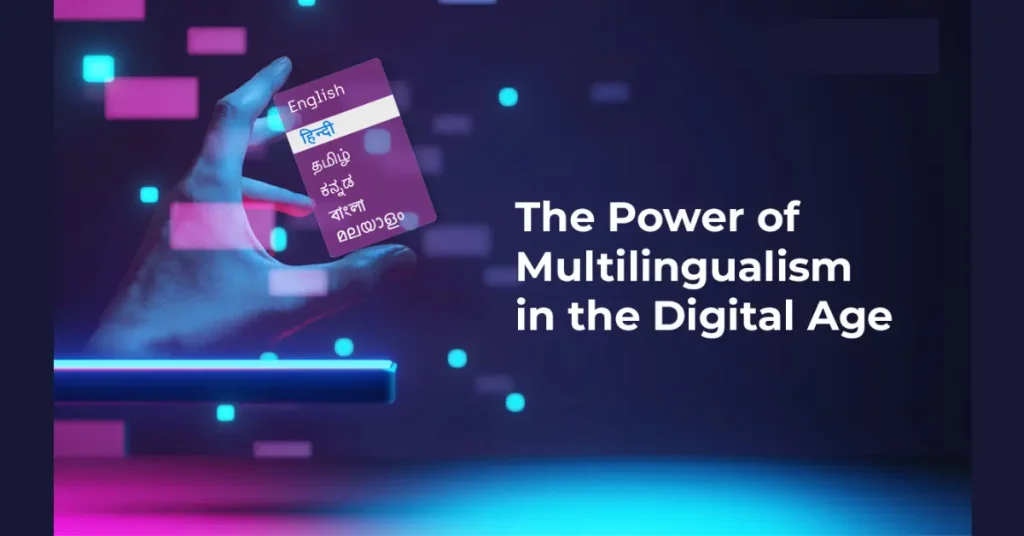
Truth #3: India's Multilingual Internet Creates a Massive GEO Opportunity
India is unlike most digital markets.
The country is home to hundreds of languages and dialects.
While English remains dominant for business searches, millions of users now search in
- Bengali
- Telugu
- Tamil
- Hindi
- Gujarati
- Kannada
- Malayalam
and many other regional languages.
AI models are becoming increasingly capable of understanding and generating content across these languages.
This creates a significant GEO advantage for businesses willing to invest in multilingual content.
Traditional SEO often required separate keyword research and optimization strategies for each language.
Generative AI can bridge language barriers more effectively.
For example:
A user may ask an AI assistant in Hindi about home loans.
The AI might draw information from English-language sources while generating answers in Hindi.
This means businesses that create accurate multilingual content increase their chances of being referenced across multiple language audiences.
Many Indian brands still focus exclusively on English content.
As AI adoption grows in Tier 2 and Tier 3 cities, multilingual GEO strategies could become one of the biggest competitive advantages available.
The companies that establish authority in regional languages today may dominate AI visibility tomorrow.
Truth #4: Clicks May Decline, But Brand Influence Can Increase
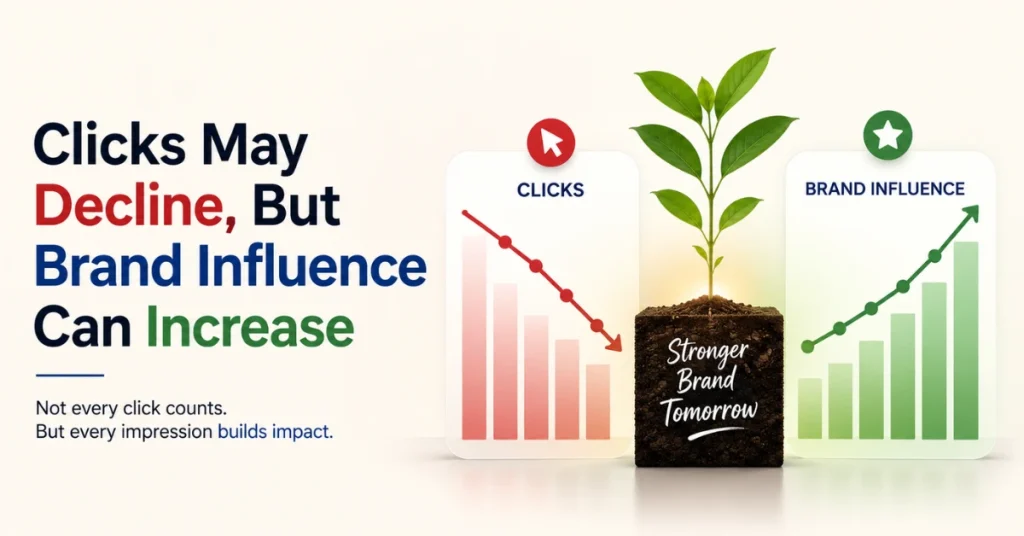
One of the most alarming statistics discussed in marketing circles is the rise of “zero-click searches.”
AI-generated answers often satisfy user intent without requiring a website visit.
At first glance, this appears disastrous.
If users don’t click, how can businesses generate leads or sales?
The answer lies in understanding the changing role of visibility.
In the past, success was measured primarily through:
- Organic traffic
- Click-through rates
- Ranking positions
Today, influence itself is becoming a measurable asset.
Imagine a user asks an AI assistant:
“Which cybersecurity firms are trusted in India?”
The AI mentions your company among its recommendations.
Even if the user never clicks immediately, your brand gains credibility and awareness.
This mirrors how traditional media worked for decades
People often remembered brands mentioned in trusted publications even without visiting their websites.
AI-generated answers function similarly.
Being repeatedly referenced by AI systems can create
- Brand recognition
- Authority
- Trust
- Recall value
For Indian startups and SMEs, this can level the playing field.
Large corporations may have bigger advertising budgets, but smaller businesses with stronger expertise can still become highly visible within AI-generated recommendations.
The future isn’t just about traffic.
It’s about influence.
Truth #5: GEO and SEO Are Not Competitors—They're Partners
Perhaps the most surprising truth is that GEO does not replace SEO.
Instead, GEO builds upon it.
Many marketers frame the discussion as:
“SEO vs GEO”
This is the wrong way to think about it.
SEO remains essential because AI systems still rely heavily on web content that is:
- Crawlable
- Well-structured
- Authoritative
- Accessible
Without strong SEO fundamentals, AI engines may struggle to discover and understand your content.
In fact, many GEO best practices overlap with modern SEO principles.
These include:
High-Quality Content
AI systems favor comprehensive, accurate, and useful information.
Structured Data
Schema markup helps machines understand content context.
Topical Authority
Deep expertise in a subject area improves both SEO and GEO performance.
Clear Content Architecture
Well-organized pages are easier for search engines and AI models to interpret.
Trust Signals
Reviews, citations, expert authorship, and references enhance credibility.
Think of SEO as building the foundation.
GEO is optimizing for how AI uses that foundation.
Businesses that excel at both will achieve the strongest visibility across future search experiences.
Why GEO Matters More in India Than Many Marketers Realize
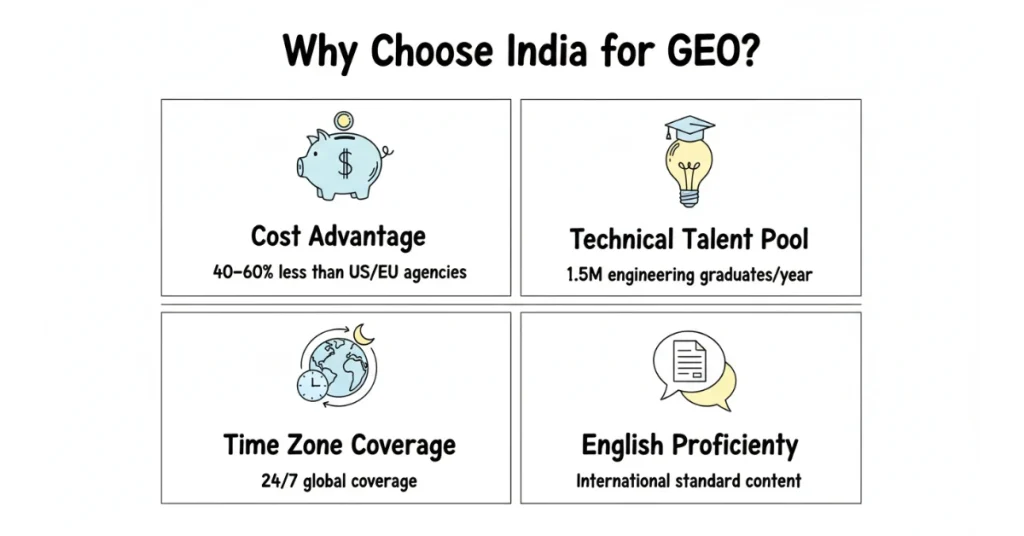
India’s digital ecosystem is uniquely positioned for AI-driven search growth.
Several factors are accelerating this shift:
Rapid Smartphone Adoption
Millions of users access the internet primarily through mobile devices.
AI assistants offer faster information retrieval than traditional browsing.
Growing AI Awareness
Consumers are increasingly experimenting with ChatGPT, Gemini, Copilot, and AI-powered search tools.
Expanding Digital Commerce
From fintech to e-commerce, users seek quick answers before making purchasing decisions.
Regional Language Growth
AI’s multilingual capabilities align perfectly with India’s diverse linguistic landscape.
Startup Ecosystem Expansion
Indian startups compete aggressively for visibility, making GEO an important differentiator.
As AI becomes integrated into daily digital experiences, businesses that ignore GEO risk becoming invisible in emerging search environments.
How Indian Businesses Can Prepare for GEO Today?
The good news is that preparing for GEO doesn’t require abandoning existing marketing strategies.
Instead, businesses should focus on strengthening content quality and authority.
Here are practical steps:
Publish Original Research
Unique insights are more valuable to AI systems than recycled information.
Build Topic Authority
Cover subjects comprehensively rather than creating isolated articles.
Strengthen E-E-A-T Signals
Experience, Expertise, Authoritativeness, and Trustworthiness matter more than ever.
Create Multilingual Content
Reach users across India’s diverse language ecosystem.
Use Structured Data
Help search engines and AI systems understand content context.
Focus on Brand Mentions
Build authority across industry publications, podcasts, forums, and media platforms.
The Future of Search Is Hybrid
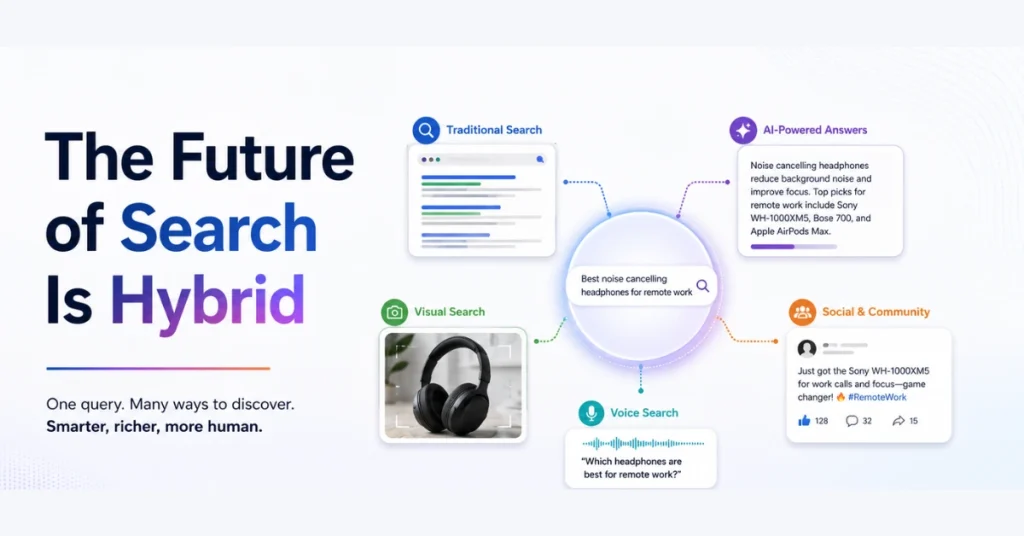
The future isn’t traditional search or AI search.
It’s both
Users will continue to:
- Search on Google
- Ask voice queries
- Use AI assistants
- Explore social platforms
- Consult specialized search tools
Visibility will increasingly depend on being present across multiple discovery channels.
GEO represents the next evolution of digital marketing, not its replacement.
Businesses that understand this distinction will gain a significant advantage.
Those waiting for AI trends to settle may discover that their competitors have already established authority in the new search ecosystem.
Final Thoughts

The conversation around AI and search is often filled with extremes.
Some claim SEO is dead.
Others argue AI is overhyped.
The reality lies somewhere in between.
AI is transforming how information is discovered, evaluated, and consumed. GEO has emerged as a critical strategy for ensuring that brands remain visible in this new environment.
For Indian businesses, the opportunity is enormous.
The country’s vast internet population, multilingual audience, and accelerating AI adoption create the perfect conditions for GEO to become a major competitive advantage.