Building a Future-Ready Ecommerce Business with Composable Commerce in 2026
Composable commerce is a modular approach to ecommerce that allows businesses to select and combine best-of-breed technologies to create a customized digital commerce ecosystem.
Instead of relying on a single monolithic platform, brands can choose individual solutions for:
- Product Information Management (PIM)
- Content Management Systems (CMS)
- Shopping Cart
- Search and Discovery
- Payment Processing
- Customer Relationship Management (CRM)
- Marketing Automation
- Analytics
These components communicate through APIs, enabling businesses to create a flexible and scalable ecommerce infrastructure.
Table of Contents
ToggleHow Composable Commerce Works
Composable commerce is built around the concept of assembling independent services that work together seamlessly.
The architecture typically includes:
Microservices
Each business function operates independently. For example, product management, checkout, and inventory systems can be updated without affecting the entire platform.
API-First Design
APIs connect all components, ensuring smooth communication between systems.
Cloud-Native Infrastructure
Most composable commerce solutions operate in the cloud, offering better scalability, security, and performance.
Headless Commerce
The frontend customer experience is separated from backend operations, allowing brands to create unique shopping experiences across multiple channels.
Table of Contents
Why Composable Commerce Matters in 2026

Modern consumers interact with brands through websites, mobile apps, social media, marketplaces, voice assistants, and AI-powered shopping platforms.
Businesses need the flexibility to adapt quickly.
Composable commerce enables brands to:
- Launch new features faster
- Integrate emerging technologies
- Improve customer experiences
- Scale globally
- Reduce vendor lock-in
As AI-powered shopping experiences continue to grow in 2026, composable commerce provides the foundation needed for innovation.
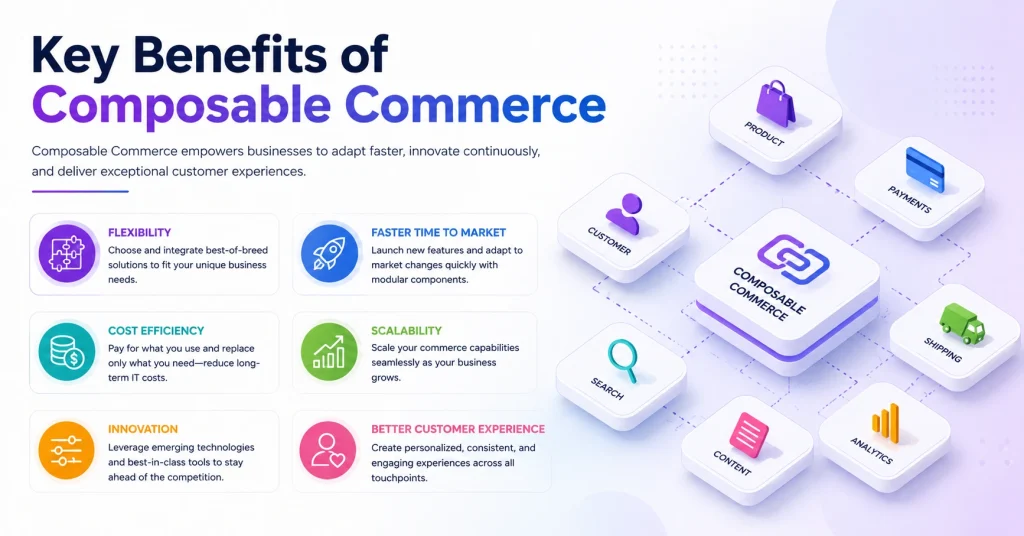
Key Benefits of Composable Commerce
Greater Flexibility
Businesses can select the exact tools they need rather than being limited by the features of a single platform.
For example, a company may choose one provider for search functionality and another for payment processing.
Faster Innovation
Teams can update or replace individual components without rebuilding the entire ecommerce system.
This significantly reduces development time and accelerates digital transformation.
Improved Customer Experience
Composable commerce allows businesses to create highly personalized shopping journeys across various channels.
Customers receive a seamless experience whether they shop through:
- Websites
- Mobile apps
- Social commerce platforms
- Marketplaces
- AI shopping assistants
- Better Scalability
As businesses grow, they can easily add new services and capabilities without disrupting existing operations.
Future-Proof Technology Stack
Instead of relying on one vendor’s roadmap, businesses can continuously adopt the latest technologies and innovations.
Traditional platforms may still work well for smaller businesses, but larger and rapidly growing brands often benefit more from composable architectures
Essential Components of a Composable Commerce Stack
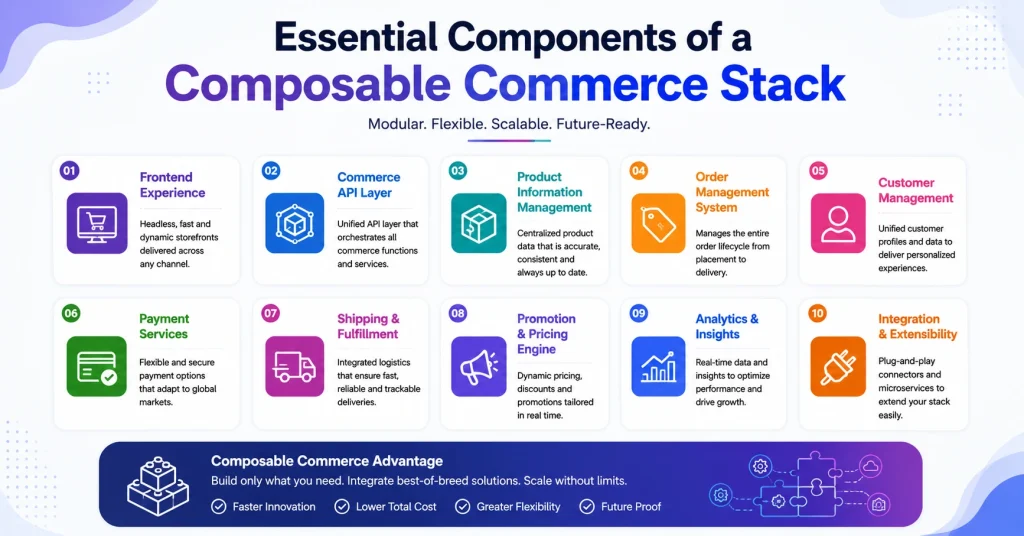
Product Information Management (PIM)
Centralizes product data across channels.
Content Management System (CMS)
Delivers content and marketing experiences.
Ecommerce Engine
Handles pricing, promotions, orders, and checkout.
Search and Merchandising
Improves product discovery and conversion rates.
Payment Gateway
Processes secure online payments.
Customer Data Platform (CDP)
Collects and analyzes customer behavior.
Analytics and Reporting
Provides actionable insights for decision-making.
The Role of AI in Composable Commerce
Artificial Intelligence is becoming a major driver of ecommerce success in 2026.
Composable commerce makes it easier to integrate AI tools for:
Personalized Recommendations
AI analyzes customer behavior to suggest relevant products.
Predictive Analytics
Brands can forecast demand and optimize inventory.
Dynamic Pricing
AI adjusts pricing based on market conditions and customer behavior.
Conversational Commerce
Chatbots and AI shopping assistants enhance customer engagement.
Automated Marketing
AI helps automate campaigns, segmentation, and content creation..
Because composable architectures are API-driven, integrating AI solutions becomes much simpler.
Industries Benefiting from Composable Commerce
Many sectors are adopting composable commerce, including:
Fashion and Apparel
Fast-changing trends require agility and rapid updates.
Electronics
Complex product catalogs benefit from flexible architectures.
Beauty and Cosmetics
Personalized shopping experiences drive conversions.
B2B Ecommerce
Custom pricing, catalogs, and workflows are easier to manage.
Healthcare and Wellness
Businesses need scalable systems that support regulatory requirements.
Challenges of Composable Commerce
While composable commerce offers many advantages, it also presents some challenges.
Technical Complexity
Managing multiple vendors and integrations requires expertise.
Higher Initial Investment
Setup costs can be higher compared to traditional platforms.
Governance Requirements
Businesses need strong operational oversight to manage various services effectively.
Skilled Development Teams
Organizations may require experienced developers familiar with APIs and microservices.
However, the long-term benefits often outweigh these initial challenges.
Best Practices for Implementing Composable Commerce
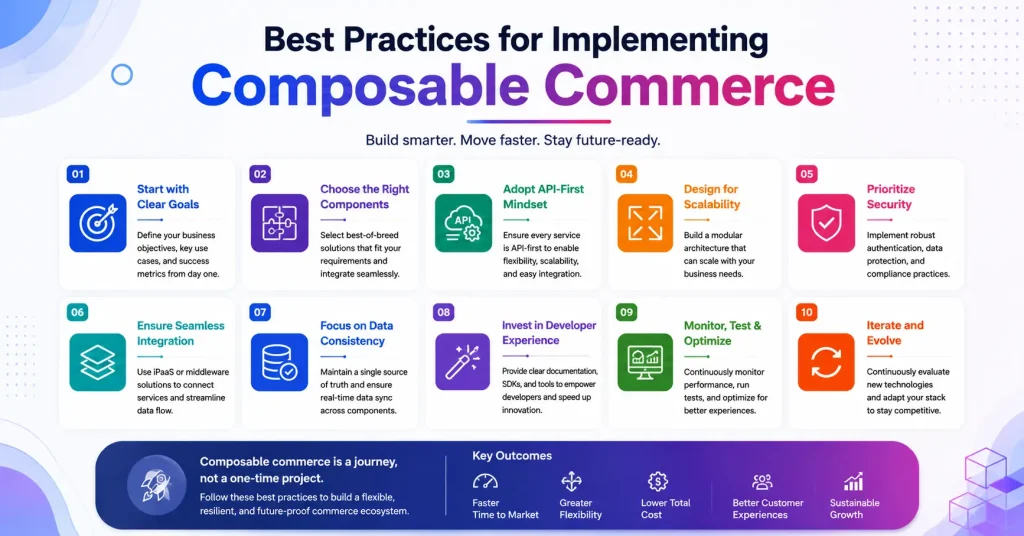
Define Business Objectives
Identify specific goals before selecting technologies.
Choose Scalable Solutions
Select vendors that support future growth.
Prioritize API Compatibility
Ensure all components integrate smoothly.
Focus on Customer Experience
Technology decisions should always improve the customer journey.
Invest in Security
Protect customer data through secure APIs and cloud infrastructure.
Monitor Performance Continuously
Use analytics tools to optimize system performance and user experiences.
Future Trends in Composable Commerce
Several trends are shaping the future of composable commerce:
- AI-driven personalization
- Voice commerce integration
- Omnichannel commerce expansion
- Augmented Reality shopping experiences
- Advanced customer data platforms
- Blockchain-based transactions
- AI shopping assistants
As these technologies mature, composable architectures will make adoption significantly easier.
Is Composable Commerce Right for Your Business?
Composable commerce is ideal for businesses that:
- Need extensive customization
- Operate across multiple channels
- Plan to scale rapidly
- Have complex product catalogs
- Want to leverage AI and emerging technologies
Smaller businesses with limited technical resources may initially prefer traditional platforms, but growing brands should seriously consider composable commerce as part of their long-term strategy.

Conclusion
Composable commerce is redefining the future of ecommerce in 2026. By replacing rigid monolithic systems with flexible, API-driven architectures, businesses gain the agility needed to adapt to changing consumer expectations and technological advancements.
From AI-powered personalization to omnichannel experiences and rapid innovation, composable commerce empowers brands to build exactly the ecommerce ecosystem they need.
As digital commerce continues to evolve, companies that embrace composable strategies will be better positioned to deliver exceptional customer experiences, accelerate growth, and maintain a competitive advantage in an increasingly dynamic marketplace.