Google Ads Smart Bidding Strategies: Which One Fits Your Business Best?
Smart Bidding is a subset of automated bidding strategies within Google Ads that uses machine learning to optimize bids for conversions or conversion value. It analyzes numerous signals such as device type, location, time of day, audience behavior, and more to determine the ideal bid for every auction.
The primary goal is to improve campaign performance while reducing the time and effort required for manual bid management.
Table of Contents
ToggleTable of Contents
Benefits of Smart Bidding
Before diving into individual strategies, let’s look at why Smart Bidding has become popular among advertisers:
- Saves time through automation
- Uses real-time auction signals
- Improves conversion performance
- Adapts quickly to changing market conditions
- Reduces manual optimization efforts
Types of Google Ads Smart Bidding Strategies
Target CPA (Cost Per Acquisition)
Target CPA helps you generate as many conversions as possible while maintaining a specific average cost per conversion.
Best For:
Lead generation campaigns
Businesses with a fixed customer acquisition cost
Service-based companies
Example:
If your business can profitably acquire customers at $20 per lead, you can set a Target CPA of $20. Google will automatically adjust bids to achieve conversions around that cost.
Pros:
- Predictable acquisition costs
- Great for lead-focused campaigns
- Easy budget planning
Cons:
- Requires sufficient conversion data
- May limit volume if CPA targets are too aggressive
Target ROAS (Return on Ad Spend)
Target ROAS focuses on maximizing conversion value while achieving a specific return on ad spend.
Best For:
- Ecommerce businesses
- Retail stores
- Businesses with varying product prices
Example:
If you set a Target ROAS of 500%, Google aims to generate $5 in revenue for every $1 spent on advertising.
Pros:
- Optimizes for revenue, not just conversions
- Excellent for online stores
- Supports profitability goals
Cons:
- Requires accurate conversion value tracking
- Needs substantial historical data
Maximize Conversions
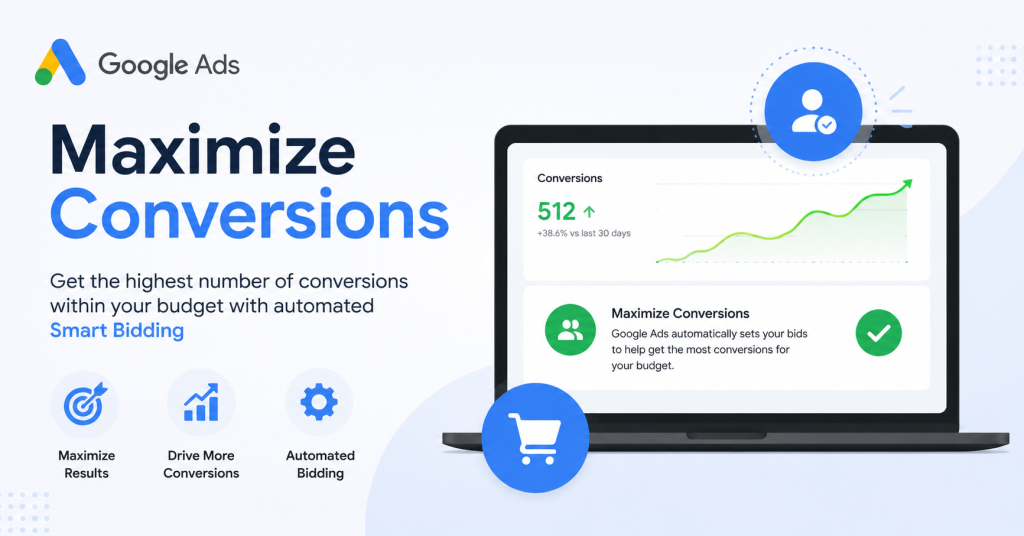
This strategy automatically sets bids to generate the highest possible number of conversions within your budget.
Best For:
- New lead generation campaigns
- Businesses focused on growth
- Advertisers without strict CPA targets
Example:
If your monthly budget is $1,000, Google will use it to generate as many conversions as possible
Pros:
- Easy to implement
- Ideal for campaign growth
- No need to set CPA targets
Cons:
- Cost per conversion may fluctuate
- Less control over acquisition costs
Maximize Conversion Value
This strategy aims to generate the highest possible conversion value within your budget.
Best For:
- Ecommerce stores
- Businesses selling products with different price points
- Revenue-focused campaigns
Example:
Google may prioritize high-value purchases over low-value ones, even if total conversion numbers decrease.
Pros:
- Focuses on overall revenue
- Helps increase average order value
- Budget-efficient
Cons:
- Requires conversion value tracking
- Helps increase average order value
- May not prioritize conversion volume
Enhanced CPC (ECPC)
Enhanced CPC is a semi-automated bidding strategy that adjusts your manual bids when Google predicts a higher likelihood of conversion.
Best For:
- Businesses transitioning from manual bidding
- Advertisers wanting more control
- Small campaigns with limited data
Example:
If your manual bid is $1.00, Google may increase or decrease it depending on conversion likelihood.
Pros:
- Combines automation with control
- Suitable for smaller accounts
- Small campaigns with limited data
Cons:
- Less automated than other Smart Bidding strategies
- Not as powerful as fully automated options
How to Choose the Right Smart Bidding Strategy
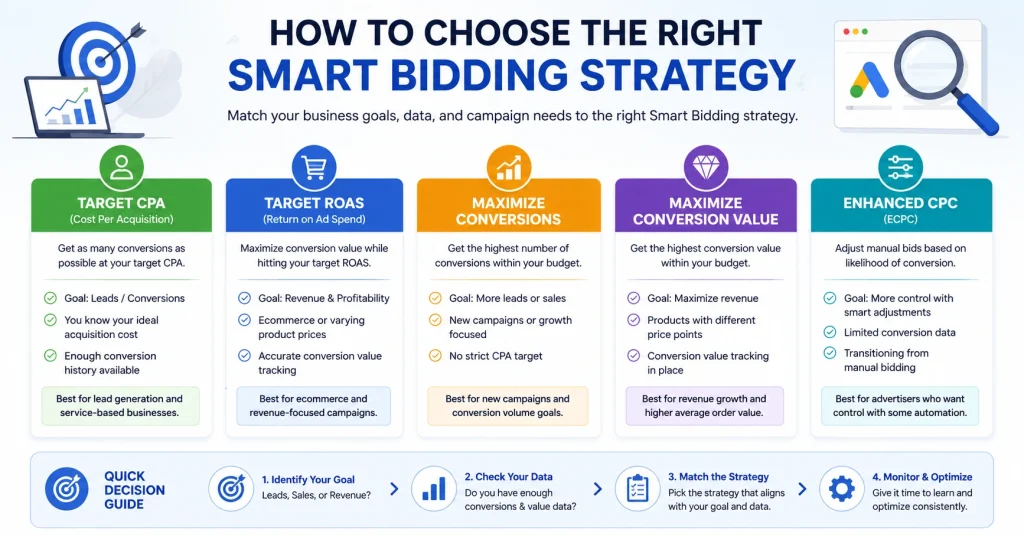
Choose Target CPA If:
- Your goal is lead generation.
- You know your ideal acquisition cost.
- You have sufficient conversion history.
Choose Target ROAS If:
- Revenue matters more than conversion volume.
- You operate an ecommerce business.
- You track conversion values accurately.
Choose Maximize Conversions If
- You want the highest number of leads or sales.
- You're launching a new campaign.
- You don't have a strict CPA requirement
Choose Maximize Conversion Value If:
- You want to maximize revenue.
- Product values vary significantly.
- Profitability is your primary goal.
Choose Enhanced CPC If:
- You prefer partial manual control.
- Your account has limited conversion data.
- You're testing automation gradually.
Common Smart Bidding Mistakes to Avoid
Not Tracking Conversions Properly
Smart Bidding relies heavily on conversion data. Inaccurate tracking can lead to poor optimization decisions.
Making Frequent Changes
Machine learning needs time to learn. Avoid changing budgets, targets, or campaign settings too often.
Setting Unrealistic Targets
Aggressive CPA or ROAS goals can limit traffic and reduce overall performance.
Ignoring the Learning Phase
New Smart Bidding campaigns often require a learning period before delivering optimal results.
Insufficient Conversion Volume
Most Smart Bidding strategies perform better when campaigns have consistent conversion data.
Best Practices for Smart Bidding Success
- Set up accurate conversion tracking.
- Allow campaigns enough time to learn.
- Use audience signals where possible.
- Review performance regularly.
- Test different bidding strategies.
- Monitor search term quality.
- Ensure sufficient budget availability.
- Align bidding strategy with business objectives
Conclusion
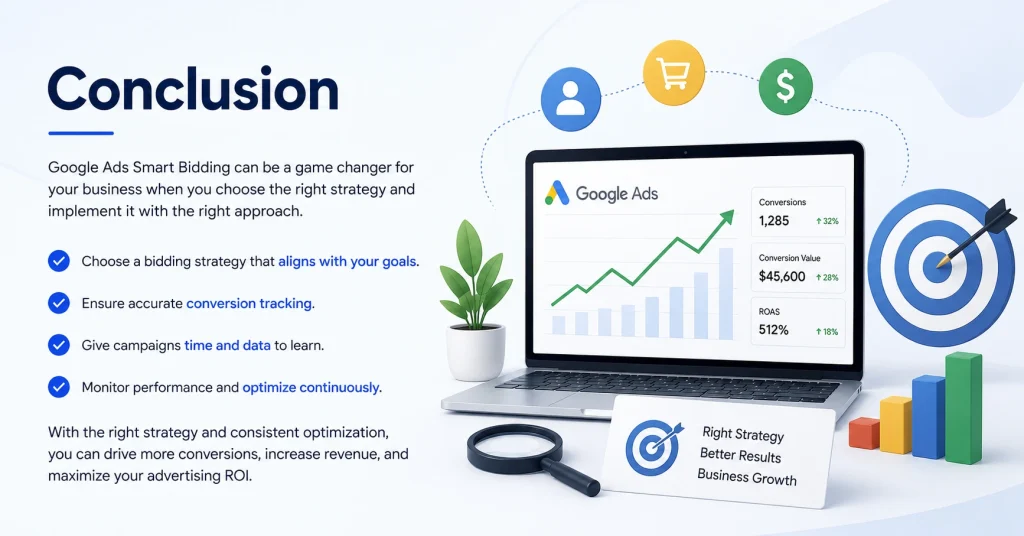
Google Ads Smart Bidding can significantly improve campaign performance when matched with the right business goals. Lead-generation companies often benefit from Target CPA or Maximize Conversions, while ecommerce brands typically achieve better results with Target ROAS or Maximize Conversion Value.
The key is to choose a strategy that aligns with your objectives, ensure accurate conversion tracking, and give Google’s machine learning system enough data and time to optimize effectively. With the right approach, Smart Bidding can help you drive more conversions, increase revenue, and maximize your advertising ROI.