Top Google Ads and PPC Trends for 2026
Top Google Ads and PPC Trends for 2026 reflect the rapid evolution of digital advertising, driven by artificial intelligence, automation, and changing consumer privacy expectations. Businesses are increasingly relying on AI-powered campaign optimization, Smart Bidding, and Performance Max campaigns to improve results while reducing manual effort. First-party data has become more valuable as third-party cookies continue to disappear, making audience targeting more privacy-focused. Advertisers are also embracing predictive analytics, creative automation, video advertising, and omnichannel strategies to reach customers across multiple platforms. In 2026, success with Google Ads and PPC depends on combining automation with human expertise, continuously testing campaigns, and using data-driven insights to maximize return on investment (ROI).
Table of Contents
ToggleTable of Contents
AI-Powered Campaigns Will Dominate
Artificial Intelligence is no longer just a feature—it’s the foundation of Google Ads.
Google continues expanding AI across campaign creation, bidding, audience targeting, and ad optimization. Advertisers who embrace AI can automate repetitive tasks while focusing on strategy and creativity.
Benefits
- Better audience targeting
- Improved bidding decisions
- Faster campaign optimization
- Higher conversion rates
- Reduced manual workload
Instead of managing every keyword manually, marketers should use AI as a powerful assistant while monitoring performance regularly.
Smart Bidding Gets Smarter
Automated bidding strategies have become far more accurate.
In 2026, Smart Bidding analyzes thousands of signals in real time, including:
Device
- Time of day
- Location
- User intent
- Search history
- Previous interactions
- Purchase likelihood
Popular bidding strategies include:
- Maximize Conversions
- Target CPA
- Target ROAS
- Maximize Conversion Value
The key is providing Google with enough conversion data for the algorithms to learn effectively.
Broad Match Keywords Continue to Improve
Broad Match has evolved significantly thanks to machine learning.
Rather than matching exact words, Google understands:
- Semantic meaning
- Related topics
- User context
- Search intent
Advertisers can reach qualified users without creating massive keyword lists.
However, negative keywords remain essential for preventing irrelevant traffic.
First-Party Data Becomes Essential
With increasing privacy regulations and the gradual decline of third-party cookies, first-party data has become one of the most valuable marketing assets.
Businesses should focus on collecting data through:
- Mobile apps
- Website forms
- Loyalty programs
- CRM systems
- Customer accounts
- Email subscriptions
Using Customer Match and audience segmentation helps create highly personalized campaigns while respecting user privacy.
Performance Max Campaigns Continue to Expand
Performance Max campaigns remain one of Google’s biggest innovations.
A single campaign can reach users across:
- Search
- Display
- YouTube
- Gmail
- Discover
- Maps
By providing high-quality assets—including images, videos, headlines, and descriptions—Google automatically finds the best combinations for each user.
Advertisers who continuously refresh creative assets typically see better performance.
Video Ads Drive More Conversions
Video consumption continues to grow across every age group.
Short-form video is becoming a key part of PPC success.
Successful video ads should:
- End with a compelling call-to-action
- Include strong branding
- Focus on one clear message
- Capture attention within the first 5 seconds
Businesses investing in YouTube Ads and video assets for Performance Max campaigns are likely to see stronger engagement.
Search Intent Matters More Than Keywords
Modern PPC focuses less on exact keywords and more on understanding why users search.
Google’s AI now evaluates:
- Commercial intent
- Buying readiness
- User behavior
- Search context
Instead of stuffing campaigns with keywords, marketers should organize campaigns around customer intent.
For example:
- Informational searches
- Product comparisons
- Purchase-ready searches
- Brand-specific searches
Intent-driven campaigns generally produce higher conversion rates.
Creative Quality Becomes a Major Ranking Factor
Automation can optimize delivery, but creativity still influences performance.
Winning ads include:
- Clear headlines
- Emotional messaging
- Strong value propositions
- Trust signals
- Social proof
- Effective CTAs
Regular A/B testing of headlines, descriptions, and visuals helps identify top-performing creatives.
Better Conversion Tracking Is a Priority
Reliable data is the foundation of successful PPC campaigns.
Businesses should ensure accurate tracking by:
- Using server-side tagging where appropriate
- Importing CRM data
- Measuring offline conversions
- Tracking phone calls
- Setting up enhanced conversions
Better tracking enables smarter bidding and more accurate reporting.
Automation Requires Human Strategy
Automation simplifies campaign management, but it doesn’t replace marketers.
Successful advertisers still need to:
- Define business goals
- Understand customer behavior
- Create compelling offers
- Develop persuasive landing pages
- Monitor campaign performance
- Test new ideas
The most successful PPC professionals combine AI efficiency with human creativity and strategic thinking.
Best Practices for PPC Success in 2026
To stay ahead of the competition, follow these best practices:
- Focus on conversion tracking before scaling campaigns.
- Continuously test ad copy and creative assets.
- Use AI tools without abandoning manual oversight.
- Build strong first-party customer data.
- Optimize landing pages for speed and user experience.
- Refresh campaigns regularly to prevent ad fatigue.
- Monitor search terms and add negative keywords.
- Measure business outcomes, not just clicks.
Common PPC Mistakes to Avoid
Even experienced advertisers make mistakes that hurt campaign performance.
Avoid these common issues:
- Ignoring conversion tracking
- Relying only on automation
- Using poor-quality landing pages
- Targeting overly broad audiences
- Not testing ad variations
- Forgetting negative keywords
- Chasing clicks instead of conversions
Regular audits can identify inefficiencies before they become expensive.
Conclusion
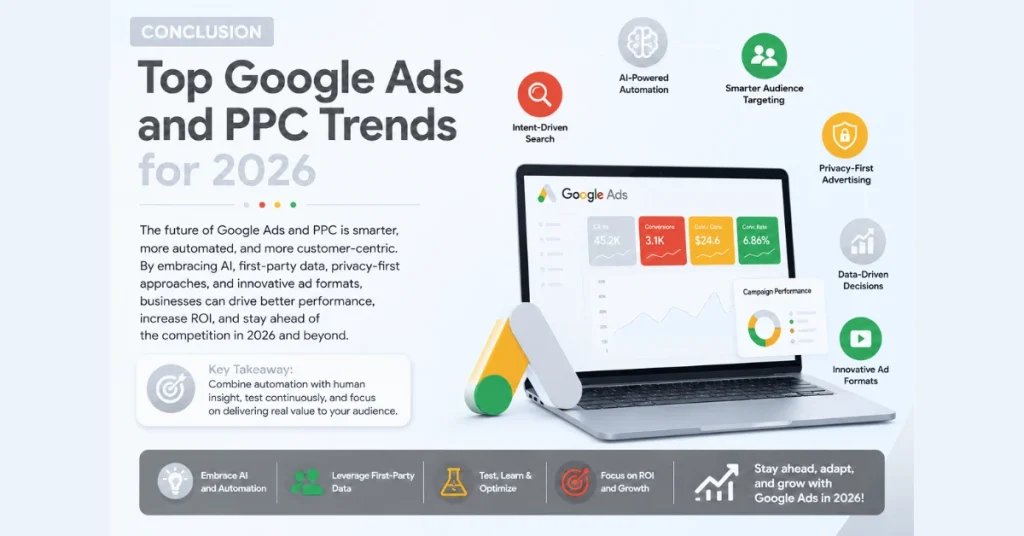
Google Ads in 2026 is more intelligent, automated, and data-driven than ever before. AI-powered bidding, Performance Max campaigns, first-party data strategies, improved audience targeting, and stronger creative assets are shaping the future of PPC advertising.
Businesses that combine automation with strategic planning, high-quality creatives, and accurate conversion tracking will be in the best position to achieve sustainable growth. Rather than resisting change, marketers should embrace these trends and continuously test, learn, and optimize their campaigns to stay ahead in an increasingly competitive digital landscape.