All-in-One Local SEO Guide to Rank Higher in Local Search Results
If you want more calls, map views, foot traffic, and local leads, local SEO should be one of your top priorities. Whether you run a neighborhood store, clinic, restaurant, service business, coaching center, salon, or multi-location brand, local SEO helps your business appear when nearby customers search for products or services like yours.
When someone types “best dentist near me,” “plastic manufacturer in Delhi NCR,” or “cafe in Gurugram,” Google tries to show the most relevant local results. If your business is optimized properly, you have a much better chance of appearing in Google Search, Google Maps, and the local pack—the set of map-based listings shown above regular search results.
This guide covers everything you need to know about local SEO: how it works, why it matters, what ranking factors influence visibility, and the exact steps you can take to improve your local search rankings.
Table of Contents
ToggleTable of Contents
What Is Local SEO?
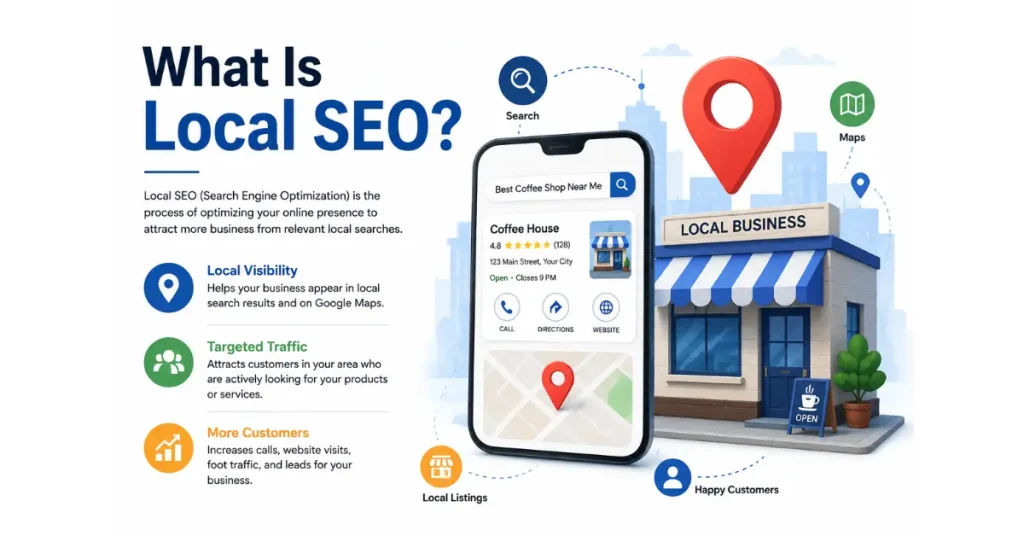
Local SEO (Search Engine Optimization) is the process of improving your online presence so your business appears in location-based search results. It focuses on helping your business rank for searches made by users in a specific area or searches with local intent.
Examples of local searches include:
“bakery near me”
“best plumber in Gurgaon”
“aluminium handles manufacturer in Faridabad”
“digital marketing agency near Delhi”
“salon open now near me”
Unlike traditional SEO, which often targets broad keywords nationally or globally, local SEO is centered around proximity, relevance, and trust within a specific region.
Local SEO helps businesses show up across:
Google Search
Google Maps
Google Business Profile listings
Local directories
Voice search results
Mobile “near me” searches
Why Local SEO Matters More Than Ever?
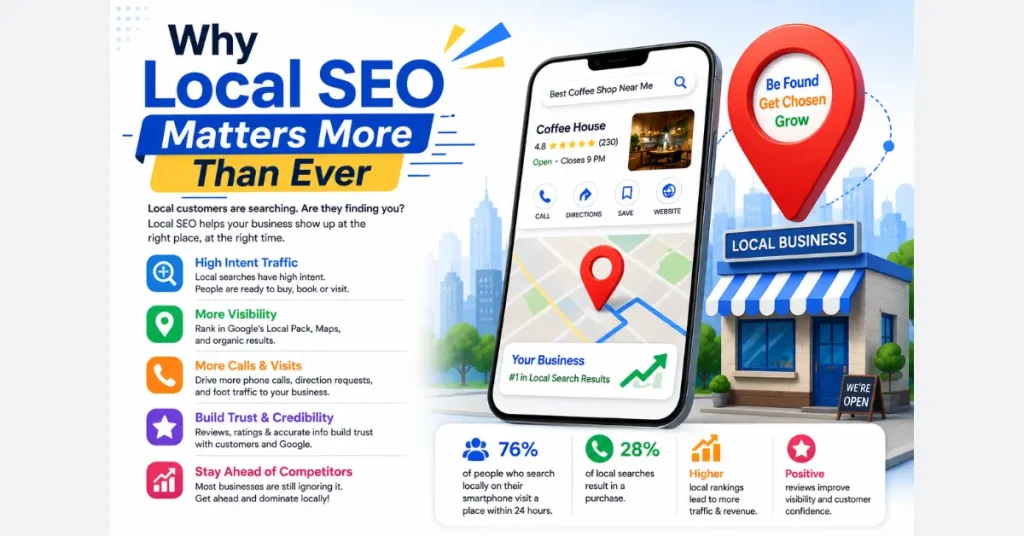
Local SEO is no longer optional for businesses serving a city, region, or neighborhood. People use search engines to find nearby businesses when they are ready to buy, book, visit, or call.
Here’s why local SEO is so valuable:
It captures high-intent traffic
Local searches usually come from people who are actively looking for a solution nearby. These users are often much closer to taking action than someone doing general research.
It increases visibility in Google Maps and local packs
Many users never scroll far enough to see standard organic listings. If your business appears in the local pack, you get premium visibility.
It drives calls, visits, and leads
Local SEO doesn’t just improve traffic; it can directly increase phone calls, direction requests, store visits, appointment bookings, and website inquiries.
It helps small businesses compete
You may not outrank a national brand for broad terms, but you can absolutely win for location-specific searches in your service area.
It builds trust and credibility
A complete Google Business Profile, positive reviews, accurate contact details, and consistent business information make your business look reliable and professional.
How Local SEO Works?
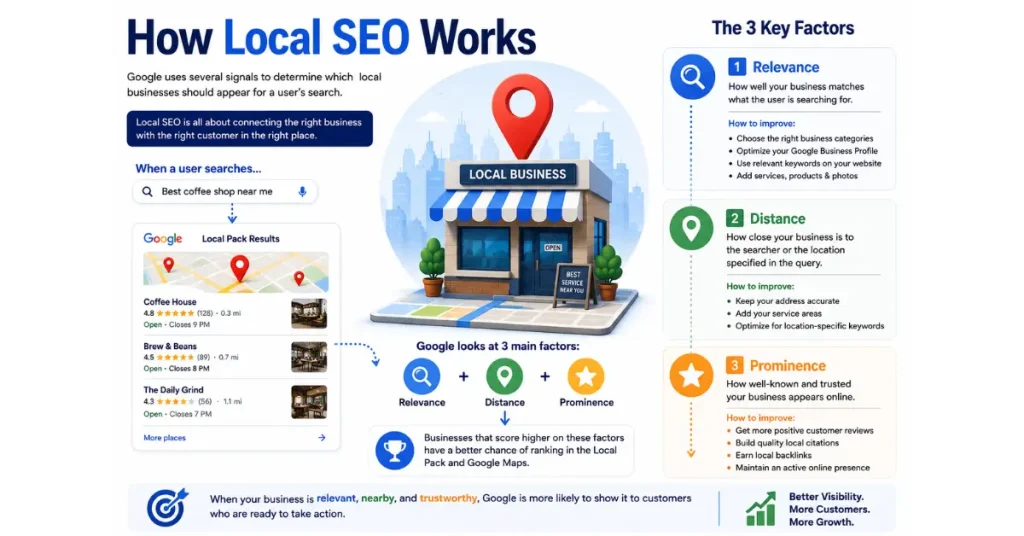
Google uses several signals to determine which local businesses should appear for a user’s search. While the exact algorithm is always evolving, local SEO generally revolves around three core factors:
Relevance
How closely your business matches what the user is searching for. If someone searches for “PVC handle manufacturer,” Google looks for businesses whose profile, website, and content clearly indicate they offer that service.
Distance
How close your business is to the searcher or the location specified in the query. A business located near the user or in the target city often has an advantage.
Prominence
How well-known and trusted your business appears online. This includes reviews, backlinks, citations, brand mentions, website authority, and overall online presence.
To improve local rankings, you need to strengthen all three of these signals.
Key Benefits of Local SEO for Businesses
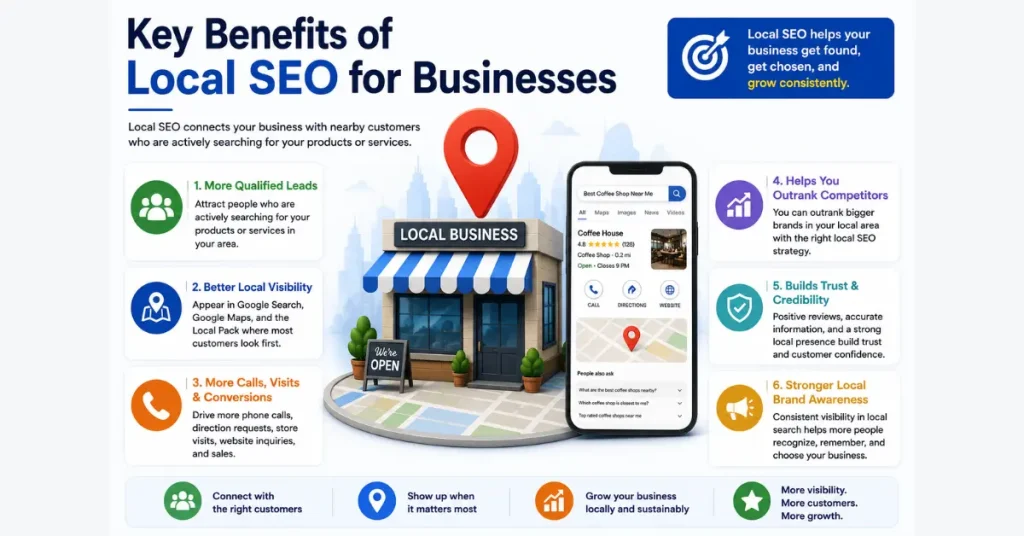
Local SEO supports growth in practical ways, especially for businesses that depend on local customers or region-based demand.
More qualified leads
You attract people who are already searching for your service in your area.
Better conversion rates
Local visitors are more likely to call, visit, request a quote, or make a purchase.
Improved map visibility
You show up when people use Google Maps to find nearby businesses.
Higher trust through reviews
Strong ratings and recent reviews can influence both rankings and customer decisions.
Stronger brand recognition locally
Even if someone doesn’t contact you immediately, seeing your business repeatedly in search results builds familiarity.
Step 1: Optimize Your Google Business Profile
Your Google Business Profile (GBP) is the most important asset in local SEO. It powers your presence in Google Maps and heavily influences local pack visibility. If you haven’t claimed your profile yet, start there immediately.
What to optimize in your Google Business Profile
1. Business name
Use your real business name exactly as it appears in the real world. Avoid adding extra keywords unnaturally.
2. Primary and secondary categories
Choose the category that best describes your main service, then add secondary categories for related offerings. Categories help Google understand what your business does.
3. Address and service area
Add your correct address if customers visit your location. If you serve customers at their location, define your service area clearly.
4. Phone number and website
Use your primary local phone number and link to the most relevant page on your website.
5. Business hours
Keep your hours accurate, including holiday hours and special opening times.
6. Business description
Write a clear description that explains who you are, what you do, where you serve, and what makes you different. Include local relevance naturally.
7. Photos and videos
Upload real, high-quality images of your location, team, products, work samples, storefront, and services. Fresh photos help engagement and trust.
8. Products and services
List your services or product categories in detail. This gives Google more context and helps customers understand your offerings.
9. Posts and updates
Publish regular updates, offers, announcements, events, product highlights, or educational posts to keep the profile active..
10. Questions and answers
Monitor and answer questions on your profile. You can also seed common FAQs yourself and answer them clearly.
Tips for better Google Business Profile performance
- Complete every section of your profile
- Keep details updated
- Add location-specific service information
- Use keywords naturally, not excessively
- Encourage real customers to leave reviews
- Reply to reviews consistently
- Upload new photos regularly
Step 2: Make Sure Your NAP Is Consistent Everywhere
NAP stands for Name, Address, and Phone Number. Your NAP details must be consistent across all platforms where your business appears online.
That includes:
- Your website
- Google Business Profile
- Facebook page
- Justdial, IndiaMART, Sulekha, Yelp, Yellow Pages, etc.
- Industry directories
- Local business listings
- Chamber of commerce or association listings
Why NAP consistency matters?
If your business name is written differently across platforms, or if your phone number and address vary, search engines may lose confidence in your business information. That inconsistency can hurt rankings and confuse customers.
Best practices:
- Use one standard business name format
- Use one primary phone number
- Write the address the same way everywhere
- Update old listings if you’ve moved or changed numbers
- Check for duplicate listings and merge/remove them where possible
Step 3: Do Local Keyword Research
Local keyword research helps you understand exactly how people search for your products or services in your area. Instead of targeting only generic terms, you need keywords with local intent.
Types of local keywords to target
Service + city
Examples:
digital marketing agency in Gurgaon
dentist in Faridabad
plastic parts manufacturer in Delhi NCR
Service + near me
Examples:
bakery near me
local SEO expert near me
hardware shop near me
Service + neighborhood or area
Examples:
gym in Sector 14 Gurgaon
tuition classes in South Delhi
Problem-based local searches
Examples:
emergency electrician in Noida
same day AC repair in Gurgaon
How to find local keywords
Use tools and methods like:
- Google autocomplete
- People Also Ask
- Related searches at the bottom of Google
- Google Search Console
- Keyword research tools such as Ahrefs, Semrush, Ubersuggest, or Keyword Planner
- Competitor websites and title tags
- Google Business Profile categories and competitor listings
- What to look for in local keywords
- Clear buying or service intent
- City, area, or “near me” modifiers
- Relevance to your services
- Reasonable competition level
- Opportunity to create dedicated pages or content
Step 4: Optimize Your Website for Local Search
A strong Google Business Profile is not enough. Your website should clearly support your local relevance and provide search engines with strong signals about your business, services, and locations.
On-page local SEO essentials
1. Include location keywords naturally
Use local keywords in: Page titles, Meta descriptions, H1 and H2 headings, Body content, Image alt text where relevant, URL slugs when appropriate
2. Create dedicated service pages
If you offer multiple services, give each major service its own page instead of listing everything on one generic page.
3. Create location pages if you serve multiple areas
If your business operates in more than one city or region, create unique pages for each location or service area. These pages should not be thin duplicates.
They should include:
Local service details
Unique content
Testimonials from that area if available
Relevant FAQs
Nearby landmarks or service details
Specific contact information if applicable
4. Add your NAP to the website
Display your business name, address, and phone number in the footer or contact page. Make it easy for both users and search engines to find.
5. Embed a Google Map
Adding a map to your contact page or location pages can reinforce local relevance and help users.
6. Improve internal linking
Link related service pages, blog posts, FAQs, and location pages together. Internal links help Google understand your site structure and topical relevance.
Step 5: Create Location-Focused Content
Content is a major part of local SEO. Publishing useful, location-relevant content can help you rank for more searches and build authority in your market.
Content ideas for local SEO
“Best [service] tips for homeowners in [city]”
Local event participation updates
Case studies from local clients
Area-specific service pages
“How to choose a [service provider] in [city]”
Seasonal local guides
FAQ posts answering common local customer questions
Why this works
Local content helps you target long-tail searches, build trust, and show Google that your business is genuinely relevant to a specific place.
Step 6: Get More High-Quality Reviews
Reviews are one of the strongest local SEO and conversion signals. They affect both rankings and customer trust.
Why reviews matter
- They improve credibility
- They increase click-through rates
- They influence local rankings
- They help customers choose between similar businesses
How to get more reviews
- Ask satisfied customers at the right time
- Send a follow-up WhatsApp or email after service
- Use a direct review link
- Train your staff to request reviews politely
- Add review request reminders on invoices, packaging, or thank-you messages
How to respond to reviews
Always respond professionally—both to positive and negative feedback. Thank happy customers and address concerns respectfully when someone leaves a poor review. Active review management shows you care about customer experience.
- Review tips
- Don’t buy fake reviews
- Don’t pressure customers with scripted wording
- Aim for steady review growth over time
- Encourage detailed reviews mentioning the service or product
Step 7: Build Local Citations
A citation is any online mention of your business’s name, address, and phone number. Citations help search engines verify your business information and improve local trust signals.
Common citation sources
- Google Business Profile
- Justdial
- Sulekha
- IndiaMART
- Yelp
- Yellow Pages
- Industry-specific directories
- Local association websites
- Business listing sites
- Citation best practices
- Keep your NAP identical across listings
- Fill out every profile completely
- Add website, hours, categories, and photos when possible
- Remove duplicates
- Focus on quality directories rather than random spammy listings
Step 8: Earn Local Backlinks
Backlinks remain an important ranking factor, including for local SEO. When trusted local websites link to your business, it strengthens your authority and local prominence.
Ways to earn local backlinks
- Partner with local businesses
- Sponsor local events, schools, or community activities
- Join business associations
- Get featured in local news websites or blogs
- Publish useful local resources people want to reference
- Build relationships with local influencers or community groups
- Good backlink opportunities
- Local newspapers and magazines
- Chamber of commerce websites
- City business directories
- Vendor and partner websites
- Local event pages
- Industry associations
Step 9: Add Local Schema Markup
Schema markup is structured data added to your website to help search engines understand your business information more clearly.
For local SEO, schema can support details like:
- Business name
- Address
- Phone number
- Opening hours
- Service area
- Reviews
- Website URL
- Business type
Using local business schema can improve how clearly Google interprets your business details, even if it doesn’t guarantee rich results.
Step 10: Make Your Website Fast and Mobile-Friendly
A huge percentage of local searches happen on mobile devices. If your site loads slowly, is hard to use on a phone, or has a poor contact experience, you’ll lose both rankings and customers.
Focus on:
Fast page load speed
Mobile-responsive design
Clear click-to-call buttons
Easy navigation
Readable fonts and spacing
Simple forms
Compressed images
Secure HTTPS connection
Google also pays close attention to user experience signals. A better site experience can improve engagement and conversions.
Step 11: Track Local SEO Performance
You can’t improve what you don’t measure. Track both ranking and business outcomes to understand what’s working.
Key local SEO metrics to monitor
- Google Business Profile views
- Calls from GBP
- Direction requests
- Website clicks from GBP
- Rankings for target local keywords
- Organic traffic to location and service pages
- Contact form submissions
- Review growth and average rating
- Conversions from local landing pages
- Tools to use
- Google Business Profile
- Insights
- Google Search Console
- Google Analytics
- Rank tracking tools
- Call tracking software if relevant
Common Local SEO Mistakes to Avoid: Even strong businesses often lose rankings because of avoidable issues. Watch out for these mistakes:
- Incomplete Google Business Profile: Leaving sections empty reduces relevance and trust.
- Inconsistent NAP details: Different phone numbers, business names, or addresses confuse search engines.
- Ignoring reviews: Not asking for reviews—or not responding to them—can hurt both visibility and conversions.
- Thin location pages: Copy-paste pages for multiple cities usually don’t perform well.
- Keyword stuffing: Overusing city names or service terms can make content unreadable and spammy.
- Poor mobile experience: A slow or clunky mobile site can cost you leads quickly.
- No local content strategy: If your site never addresses local questions, neighborhoods, or service areas, you miss many ranking opportunities.
A Simple Local SEO Action Plan
If you want a practical roadmap, follow this order:
Week 1
Claim and verify your Google Business Profile
Complete every profile field
Standardize your NAP everywhere
Audit your existing citations
Week 2
Research local keywords
Optimize homepage, service pages, and contact page
Add local business schema
Improve mobile usability and speed
Week 3
Create one or more location/service pages
Add photos, FAQs, and local proof
Start asking customers for reviews
Week 4
Build citations on quality directories
Publish a local blog post or guide
Reach out for local backlinks
Set up performance tracking
Then repeat, improve, and expand month by month.
Final Thoughts
Local SEO is one of the most powerful digital marketing channels for businesses that serve a specific geographic area. It helps you appear where your ideal customers are already searching—Google Search, Google Maps, and local business listings—at the exact moment they need a solution.
The businesses that rank well locally are usually not the ones doing one big trick. They are the ones consistently getting the basics right: a strong Google Business Profile, accurate business details, targeted local keywords, useful website content, real customer reviews, quality citations, local backlinks, and a smooth mobile experience.
If you focus on these fundamentals and keep improving over time, your local rankings can become a steady source of leads, calls, visits, and revenue.
Local SEO is not just about ranking higher. It is about becoming the most visible, trusted, and relevant option in your area.